



Resistance Training After 35: Why Bands Beat Weights
At some point after 35, a strange thing happens to a lot of people who lift weights.
You stop caring quite as much about impressing the guy on the next bench.
You start caring a lot more about whether your shoulder is going to hurt tomorrow.
You still want muscle.
You still want to be strong.
You still want to look good.
But you also want to feel good, move well, get your workout done without reorganizing your entire day, and still be able to do it 10 or 20 years from now.
That changes everything.
And it raises a question the fitness industry rarely asks:
If your priorities have changed, why are you still assuming the same training tools are automatically the best ones?
For decades, conventional strength training has been built around a simple idea:
If you want to get stronger, lift progressively heavier weights.
More plates.
Heavier dumbbells.
Bigger stack.
It's easy to measure, easy to understand and unquestionably effective.
But there's a problem.
The weight stays constant throughout the repetition. Your ability to produce force doesn't.
That mismatch is exactly why we think variable resistance training deserves a much bigger role for adults over 35.
Not because barbells suddenly become dangerous.
Not because dumbbells stop building muscle.
And not because resistance bands possess some magical property that makes conventional training obsolete.
They don't.
Our argument is simpler:
After 35, the goal shouldn't be to make training easier. It should be to put hard resistance where your body can use it best.
That's what variable resistance training is designed to do.
And for a lot of people, we think that's a smarter way to train.
The Problem Isn't Weight. It's Constant Weight.
Imagine you're performing a squat.
At the bottom, your leverage is relatively poor. Getting out of that position is usually much harder than finishing the rep near the top.
Now imagine squatting 200 pounds.
It's 200 pounds at the bottom.
It's 200 pounds halfway up.
It's 200 pounds at the top.
The bar doesn't know that your leverage changed.
It doesn't care that one portion of the exercise is mechanically harder than another.
Your body has to accommodate the weight.
That means how much you can lift through the entire repetition is often determined by how much you can get through your weakest portion.
Exercise scientists commonly refer to this changing ability to produce force throughout a movement as a strength curve.
And this is the idea that makes variable resistance training so interesting.
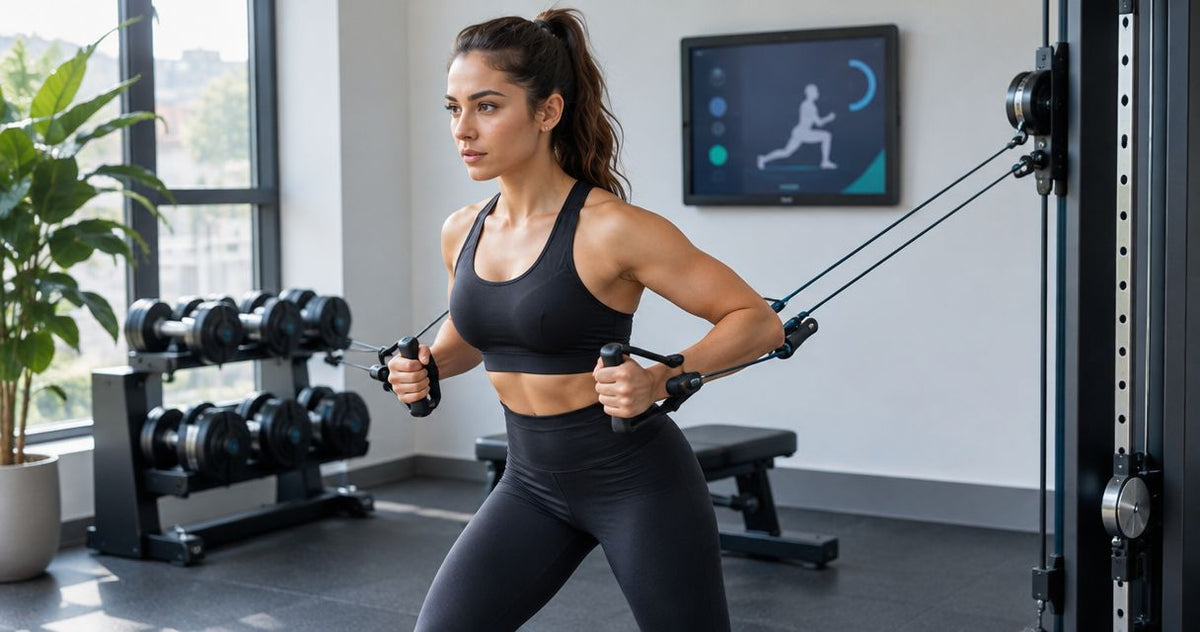
Instead of forcing your body to adapt to one constant external resistance, variable resistance changes the load as you move.
With elastic resistance bands, that happens naturally.
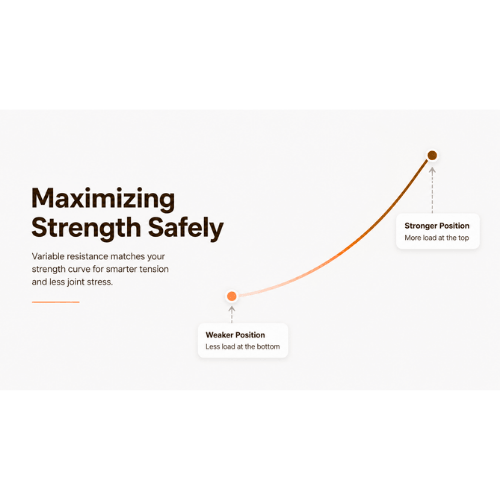
The farther the band stretches, the more resistance it produces.
On exercises with an ascending strength curve, that can mean:
Less resistance where you're mechanically weaker.
More resistance as your leverage improves.
Weak position → lighter resistance.
Stronger position → heavier resistance.
That's not making the exercise easier.
It's changing where the exercise becomes hardest.
And that's an important distinction.
After 35, I Think We Should Be Asking a Different Question
Traditional strength culture loves one question:
How much can you lift?
It's a useful metric.
It's also not the only one that matters.
If you're a competitive powerlifter, your ability to squat, bench or deadlift the most weight possible is obviously important.
If you're 43, work 50 hours a week, have two kids, want more muscle, want to lose some fat and would prefer your shoulders still function normally at 60?
I'd argue there's a better question:
How much productive resistance can you consistently train against?
That changes the conversation.
Because the hardest possible workout isn't automatically the best workout.
The heaviest possible resistance isn't automatically the most productive resistance.
And being completely wrecked after training isn't proof that the workout worked.
What matters is whether the training provides enough stimulus to create adaptation and whether you can recover from it well enough to come back and do it again.
And again.
And again.
That's where results actually come from.
No, Your Body Doesn't Fall Apart at 35
We should clear this up before going any further.
Thirty-five is not a biological cliff.
You don't wake up on your 35th birthday to discover your joints have expired and resistance bands are now mandatory equipment.
Plenty of people begin serious barbell training in their 40s, 50s and beyond.
That's not the argument.
Thirty-five matters because, for many people, life changes before physiology forces it to.
Your schedule gets more complicated.
You may have accumulated a few old injuries.
You've probably spent more years sitting at a desk, driving, working, parenting or simply doing things that compete with training.
Recovery starts becoming something you actually pay attention to.
And perhaps most importantly, you're no longer trying to become strong for next summer.
You're trying to stay strong for the next several decades.
That's a fundamentally different goal.
And different goals deserve different tools.
The Case for Variable Resistance After 35
You Don't Need Less Resistance. You Need Better-Placed Resistance.
This is the part people sometimes misunderstand about bands.
Resistance bands aren't inherently "light training."
A properly loaded band can create enormous resistance.
The difference is how that resistance develops.
As an elastic band stretches, resistance increases.
That means you can create an exercise where the loading profile changes with you.
Researchers describe variable resistance training as a way to better accommodate the changing force-producing capacity that occurs throughout a movement.
That's the concept.
Not:
bands are easy.
But:
resistance doesn't have to remain constant.
That opens up an entirely different way to think about strength training.
The Weakest Inch Doesn't Have to Control the Entire Exercise
Think about the bench press.
There may be a portion near the bottom where you're significantly weaker than you are closer to lockout.
With traditional resistance, the weight has to be light enough for you to survive that sticking region.
Once you're through it, your leverage may improve substantially.
But the bar hasn't become heavier.
So part of your potential strength in the stronger range goes unused.
Variable resistance can change that.
The band contributes progressively more resistance as it stretches.
Now the exercise can continue challenging you as your mechanical advantage improves.
This doesn't perfectly match every human strength curve.
And not every exercise benefits equally from the same resistance profile.
That's important.
But on the right movements, it's a very useful tool.
Instead of selecting resistance based entirely on your weakest point, you're creating more opportunity to challenge stronger portions of the movement too.
This Isn't Just Fitness Marketing
Here's where the argument becomes more interesting.
Variable resistance used to be treated largely as a specialized method used by powerlifters and strength coaches.
Bands and chains would be added to barbells to change resistance through squats, bench presses and deadlifts.
The idea wasn't that elastic resistance was somehow inferior to weights.
Quite the opposite.
Elite strength athletes were deliberately adding variable resistance because of what it could do to the loading profile.
Research has continued examining that idea.
A 2022 review and analysis concluded that variable resistance and traditional resistance training were generally similarly effective for improving maximal strength and muscle power.
But newer research has moved the conversation forward.
A 2026 review and analysis published in the Journal of Strength and Conditioning Research found that, across the included long-term studies, variable resistance training produced greater improvements in maximal strength than free-weight training, although the size of the advantage was modest and outcomes varied according to how the variable resistance was applied. [1]
That's worth paying attention to.
Because the old argument was:
"Bands can work too."
The emerging argument is:
"Under the right conditions, changing the resistance through the movement may actually offer an advantage."
But Does Variable Resistance Build More Muscle?
Here's where we're going to disappoint anyone looking for a miracle claim.
Maybe, maybe not.
At least the current evidence doesn't justify saying that variable resistance automatically produces more muscle growth than conventional resistance training.
A review examining VRT versus conventional resistance found similar improvements in muscle hypertrophy, with no significant overall advantage for variable resistance in the studies analyzed. [2]
We think that's good news.
Seriously.
Because resistance bands don't need magic to make a compelling case.
If variable and conventional resistance can both build muscle effectively, then the decision can come down to other things that matter enormously in real life:
How easily can you train?
Can you progressively increase resistance?
How much equipment do you need?
Can you train at home?
Can you take it with you?
Do you like the way the exercises feel?
Can you recover and repeat the workout?
Will you still be doing it six months from now?
Those aren't footnotes.
For most people, they're the entire game.
Muscle Doesn't Know Whether the Resistance Is Made of Iron
Your body doesn't award additional hypertrophy points because your dumbbell was forged in a factory and weighs exactly 50 pounds.
Muscle responds to the demands placed on it.
You need meaningful mechanical tension.
You need enough effort.
You need progressive overload over time.
You need enough training volume to stimulate adaptation.
You need recovery.
And then you need to keep doing it.
Bands can provide that resistance.
Free weights can provide it.
Machines can provide it.
Cables can provide it.
The implement is not the adaptation.
The training stimulus is.
That's why dismissing resistance bands as something you use for warming up, rehabilitation or hotel workouts misses the point entirely.
The question isn't whether a band looks as impressive as a loaded barbell.
The question is whether it can challenge the muscle enough to force adaptation.
Properly used, the answer is yes.
What About Your Joints?
This is where fitness marketing tends to get reckless.
No resistance-training method guarantees injury prevention.
Exercise selection matters.
Technique matters.
Your training history matters.
Your current condition matters.
Load matters.
Range of motion matters.
How aggressively you progress matters.
But variable resistance does give you something mechanically different from a constant external load.
On exercises where your leverage improves throughout the concentric movement, resistance can increase as you move toward the stronger portion.
That can mean less external resistance in a mechanically disadvantaged position and more resistance where you can produce greater force.
For some lifters, particularly those who don't enjoy grinding heavy fixed loads through certain positions, that can make training feel dramatically different.
And once you're over 35, how training feels is not irrelevant.
If one method allows you to train hard without repeatedly aggravating something that keeps interrupting your consistency, that's not weakness.
That's just smart programming...in our opinion.
The objective isn't to prove how much discomfort you can tolerate.
The objective is to keep getting stronger.
Being Sore Isn't a Business Model for Your Body
There's an old-school idea that a good workout should destroy you.
Can't walk after leg day?
Great workout.
Can't raise your arms after chest day?
Must have crushed it.
Everything hurts?
Progress.
Except soreness isn't the goal.
Adaptation is.
There is a difference between training hard enough to create a reason for your body to adapt and creating so much fatigue that you're constantly recovering from the training itself.
When you're 20 and your schedule consists of classes, pizza and figuring out what you're doing Friday night, you can sometimes get away with ridiculous training decisions.
At 45, the consequences show up faster.
Work still needs you.
Kids still need you.
The lawn apparently continues growing regardless of how many squats you did.
Your training needs to fit into your life rather than constantly competing with it.
Which brings us to the part of the variable-resistance argument nobody talks about enough.
The Biggest Advantage Might Have Nothing to Do With Biomechanics
It's friction.
Consider everything involved in a traditional gym workout.
Pack your stuff.
Drive to the gym.
Find parking.
Change.
Wait for a rack.
Load the bar.
Unload it.
Move to another station.
Wait again.
Finish.
Drive home.
A 40-minute workout can easily consume more than an hour of your day.
And that's before considering the financial cost. We've also broken down the real 12-month cost of a gym membership versus a home gym for anyone weighing the full commitment.
That's not a criticism of gyms.
Some people love that ritual.
If that's you, keep going.
But if you're repeatedly missing workouts because your training requires too much time, equipment or logistics, then your theoretically "optimal" training program isn't optimal at all.
It's imaginary.
A resistance-band system dramatically changes the logistics.
Walk into another room.
Set it up.
Train.
Put it away.
Done.
That's less exciting than talking about muscle activation or force curves.
It may also matter more.
Because training effectiveness can only compound when training actually happens.
Consistency beats theoretical perfection every time theoretical perfection stays in your calendar instead of becoming a workout.
The Real Competition Isn't Bands vs. Barbells
This is where I think most comparisons get the argument wrong.
People build charts comparing:
Resistance bands vs. dumbbells.
Resistance bands vs. barbells.
Resistance bands vs. machines.
But that's not the real competition for most adults over 35.
The real competition is:
The workout you can consistently do vs. the workout you keep skipping.
If you genuinely love the gym, train there four days a week and have no intention of stopping, great.
You don't need us to rescue you from barbells.
But if your garage rack has slowly become an expensive coat hanger...
If your gym membership has become a monthly donation...
If you keep telling yourself you'll get back into lifting once things calm down...
If you've spent the last three years "starting again Monday"...
Then perhaps the solution isn't more motivation.
Perhaps the training model has too much friction.
That's an equipment problem worth solving.
Where Traditional Weights Still Win
An opinion isn't very useful if it can't survive its exceptions.
So let's be clear.
There are situations where conventional weights are the better tool.
If your primary goal is becoming excellent at the barbell squat, you need to squat with a barbell.
If you're training for powerlifting, you need specificity.
If you want extremely precise loading where adding exactly 2.5 or 5 pounds matters, plates and dumbbells make that simple.
If you're an advanced lifter moving extremely high absolute loads, free weights and machines may make progression easier.
And some exercises simply work beautifully with traditional resistance.
We're not anti-weight.
We're anti-default.
The idea that everyone trying to get strong automatically needs a rack, bench and several hundred pounds of iron deserves to be questioned.
Especially when the person's actual goal isn't powerlifting.
Their goal is to be strong.
Those are not necessarily the same thing.
So Why Do We Prefer Bands for Most People Over 35?
Because most people aren't competing.
They're living.
They want stronger legs.
More muscle.
A better-looking chest, shoulders and arms.
A stronger back.
Better physical capacity.
The ability to carry things, move things, climb things and do normal human activities without feeling like age is slowly negotiating away their independence.
They want a workout that fits between everything else life demands.
They want enough resistance to make progress without needing a room dedicated to equipment.
And ideally, they'd like a training system that can get harder as they get stronger.
Variable resistance checks a lot of those boxes.
That's our case for it.
Not because bands are somehow "better" in every imaginable situation.
Because for the outcome most adults actually want, they solve more practical problems than traditional weights do.
What Good Variable Resistance Training Actually Requires
This is also where we need to separate serious resistance-band training from randomly pulling on a $12 exercise band.
If you're going to replace or substantially reduce traditional weight training, your system needs to behave like legitimate strength equipment.
That means you need:
Enough resistance.
Eventually you should become too strong for today's resistance.
That's the point.
Progressive overload.
You need a repeatable way to make exercises harder through greater band resistance, increased starting tension, additional range, repetitions, sets or other deliberate progressions.
Stable movement patterns.
You need to be able to press, row, squat, hinge, curl, extend and perform other movements without spending half the workout wrestling with the equipment.
Repeatability.
You should be able to recreate your setup instead of guessing every workout.
And:
A system you'll actually use.
That's the part we obsessed over when building XBAR.
This Is Where XBAR Fits
Full disclosure:
We're obviously biased.
We make a variable resistance training system.
But bias doesn't give us permission to make bad arguments.
XBAR wasn't built because barbells don't work.
They clearly do.
It was built around the idea that people shouldn't need a room full of heavy equipment to train their entire body against serious resistance.
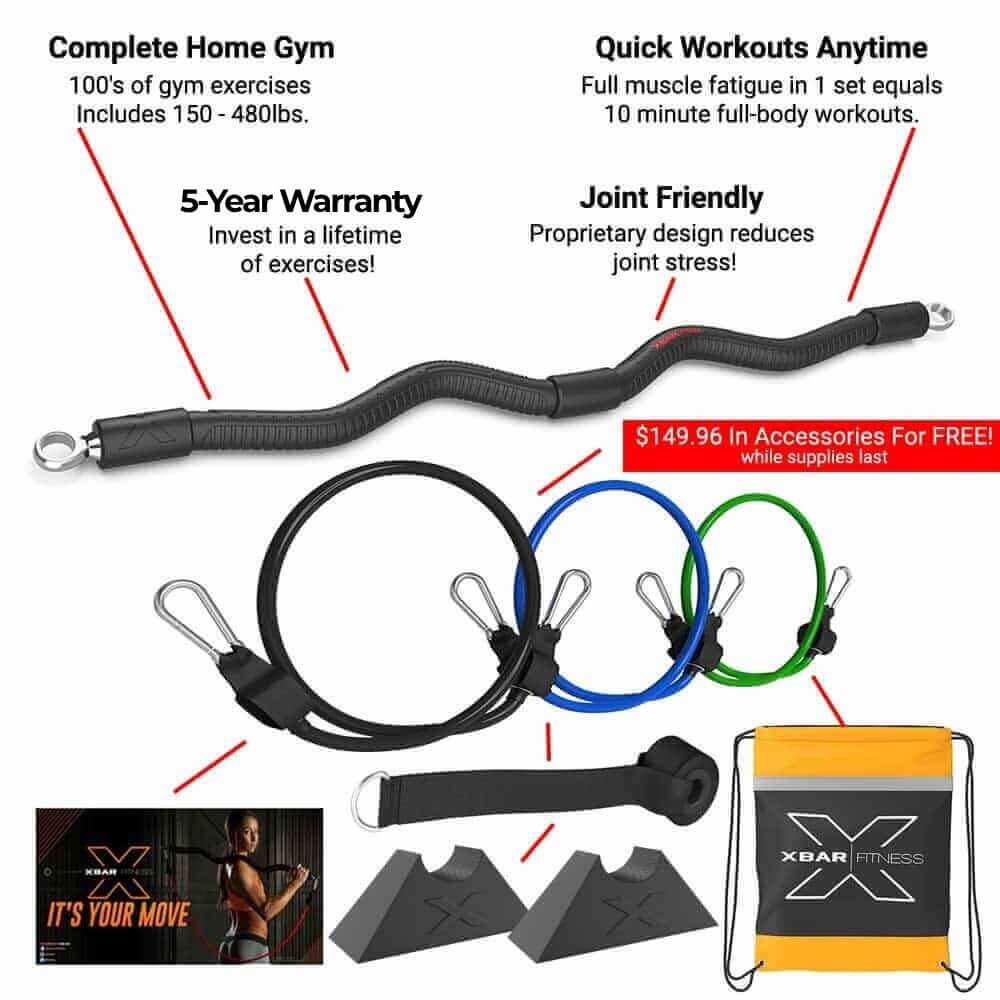
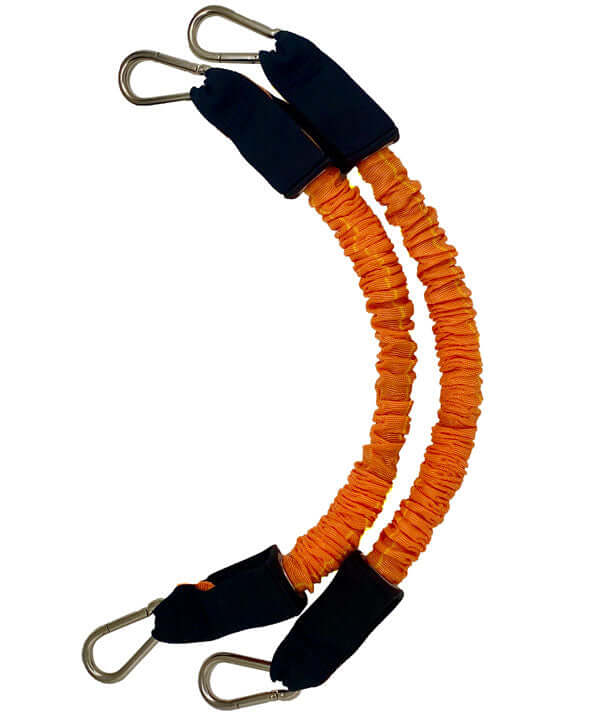
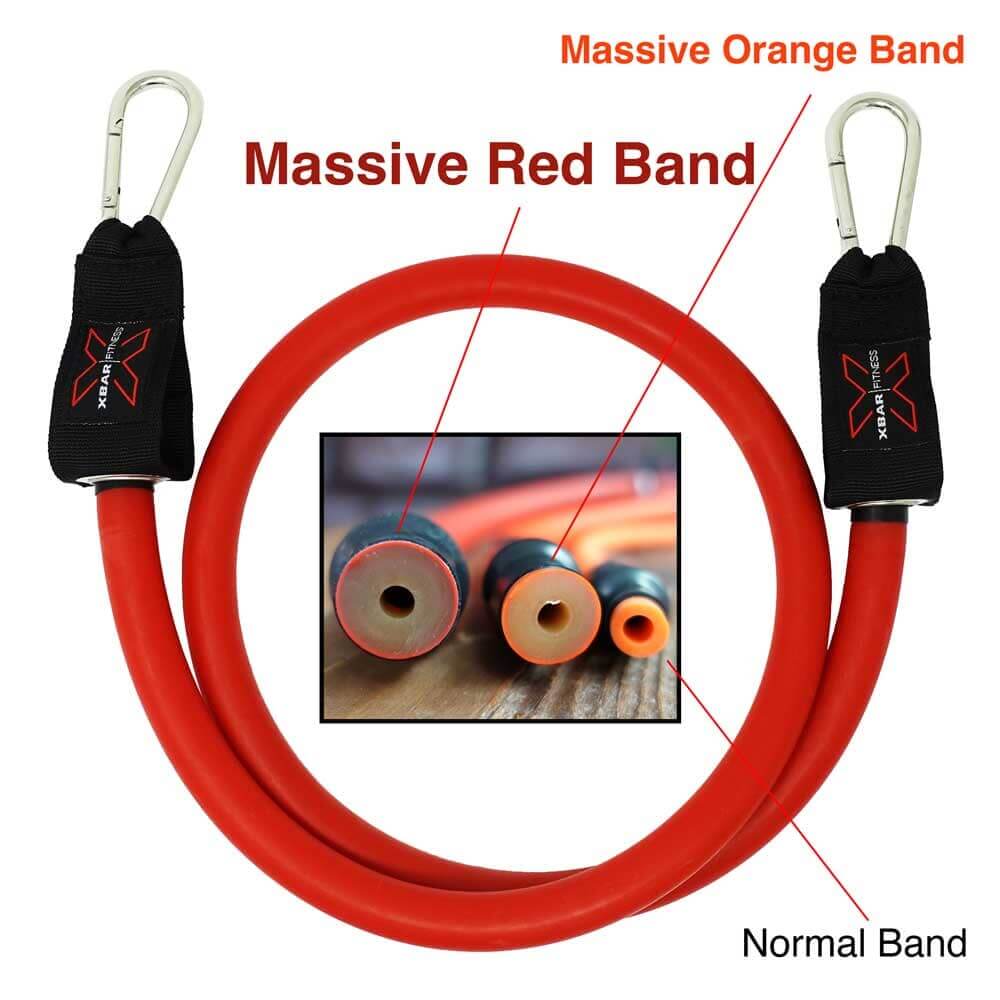
The XBAR system combines a 35-inch training bar with progressive resistance bands, anchors and accessories so you can perform the major strength-training movement patterns without building a conventional home gym.
Squats.
Presses.
Rows.
Deadlifts.
Curls.
Triceps work.
Shoulder work.
Core movements.
And dozens of variations.
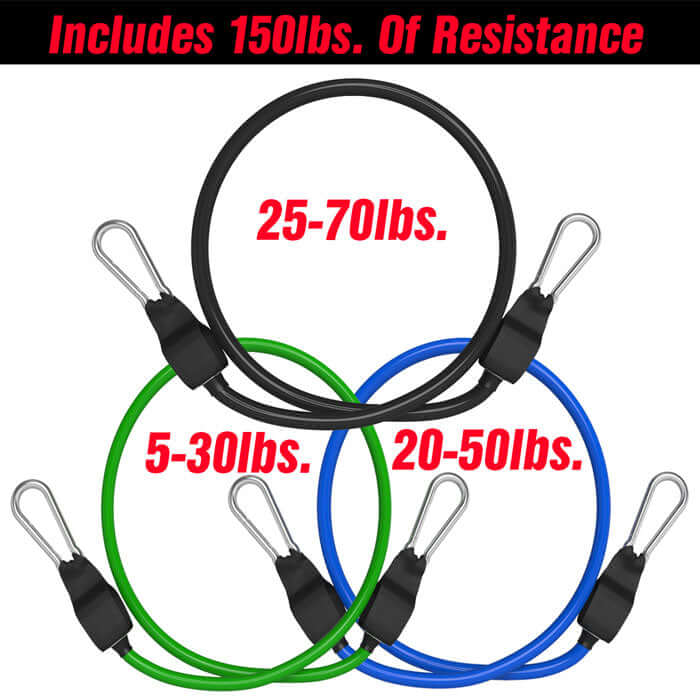
Resistance can be scaled from relatively light loads for beginners to considerably heavier configurations as strength improves.
The entire setup can be stored away instead of permanently occupying a garage or spare bedroom.
And setup takes seconds instead of requiring a commute.
That's the product advantage.
But the bigger idea is the training philosophy behind it:
Challenge the muscle. Reduce unnecessary friction. Progress the resistance. Keep showing up.
That's what we think sustainable strength training should look like.
If You're Over 35, Stop Training Like the Equipment Is the Goal
There's nothing wrong with chasing a bigger bench press.
There's nothing wrong with loving heavy dumbbells.
There's nothing wrong with having a garage full of iron.
If you enjoy it and it works for you, keep lifting.
But don't confuse tradition with necessity.
You don't need a barbell because people have always used barbells.
You don't need a gym because strength training has traditionally happened in gyms.
And you don't need to keep adding heavier fixed weights simply because "more weight" is the easiest form of progress to measure.
Your muscles need resistance.
Your body needs progression.
Your health needs consistency.
Your future self needs you to keep training.
The equipment is just how you get there.
And after 35, we think that's the shift that matters most.
Stop asking:
"What's the heaviest thing I can lift?"
Start asking:
"What's the smartest way for me to keep getting stronger?"
For a lot of people, the answer may be variable resistance.
And once you experience what it feels like to have resistance increase with you instead of simply hanging against you, conventional training starts to look a little less inevitable.
Not obsolete.
Not useless.
Just no longer the automatic default.
Ready to Experience Variable Resistance?
You don't need to rebuild your life around your workouts.
You need a resistance-training system that fits into the life you already have.
See how the XBAR variable resistance training system works and build your home strength setup.
Resistance Training After 35 Frequently Asked Questions
Is variable resistance training effective after 35?
Yes. Age 35 does not create a special physiological requirement for variable resistance, but VRT can be an effective way for adults to build strength and muscle. Research comparing variable and traditional resistance training supports VRT as a legitimate strength-training method, and a 2026 analysis found an advantage for VRT in long-term maximal-strength outcomes across the studies analyzed. [1]
Can resistance bands build muscle as effectively as weights?
Research comparing variable resistance training with conventional resistance training has found similar improvements in muscle hypertrophy overall. [2] The important factors remain sufficient resistance, effort, progressive overload, training volume and consistency.
Are resistance bands easier on your joints than weights?
Not automatically. No training implement guarantees joint safety. However, elastic resistance changes as the band stretches. On movements with an appropriate ascending strength curve, this can create less external resistance in weaker positions and greater resistance as leverage improves.
Is variable resistance better than free weights?
That depends on the goal. Free weights are an excellent choice for people who want barbell-specific strength, highly precise loading or very high absolute resistance. Variable resistance can be particularly useful for people prioritizing general strength, muscle, home training, portability, exercise variety and low-friction workouts.
Can you progressively overload resistance bands?
Yes. Progressive overload with resistance bands can include stronger bands, combining bands, increasing initial stretch, increasing repetitions or sets, improving range of motion or changing other training variables in a controlled way.
How often should adults over 35 strength train?
There is no special training frequency that begins at age 35. Frequency should reflect training experience, total volume, intensity, recovery and individual goals. For many people, two to four resistance-training sessions per week can provide an effective framework.
References
1. Li J, Chen Z, Xu K, Wang Y, Gong M. Comparison of Variable Resistance and Free Weight Training on Long-Term and Acute Effects on Different Assessments of Strength: A Systematic Review and Meta-Analysis. Journal of Strength and Conditioning Research. 2026;40(2):e211-e223.
2. Fuentes-García MA, Malchrowicz-Mośko E, Castañeda-Babarro A. Effects of Variable Resistance Training Versus Conventional Resistance Training on Muscle Hypertrophy: A Systematic Review. Sport Sciences for Health. 2024;20:37-45.
3. Andersen V, et al. Comparing the Effects of Variable and Traditional Resistance Training on Maximal Strength and Muscle Power in Healthy Adults: A Systematic Review and Meta-Analysis. Journal of Science and Medicine in Sport. 2022.
4. Li J, Chen Z, Gong M. Comparison of Muscle Activation Between Variable Resistance Training and Free Weight Training: A Systematic Review and Meta-Analysis. Journal of Human Kinetics. 2025.