



XBAR vs. Bodylastics: Which Resistance Band System Is Right for You?
By the XBAR Team | Published September 26, 2026
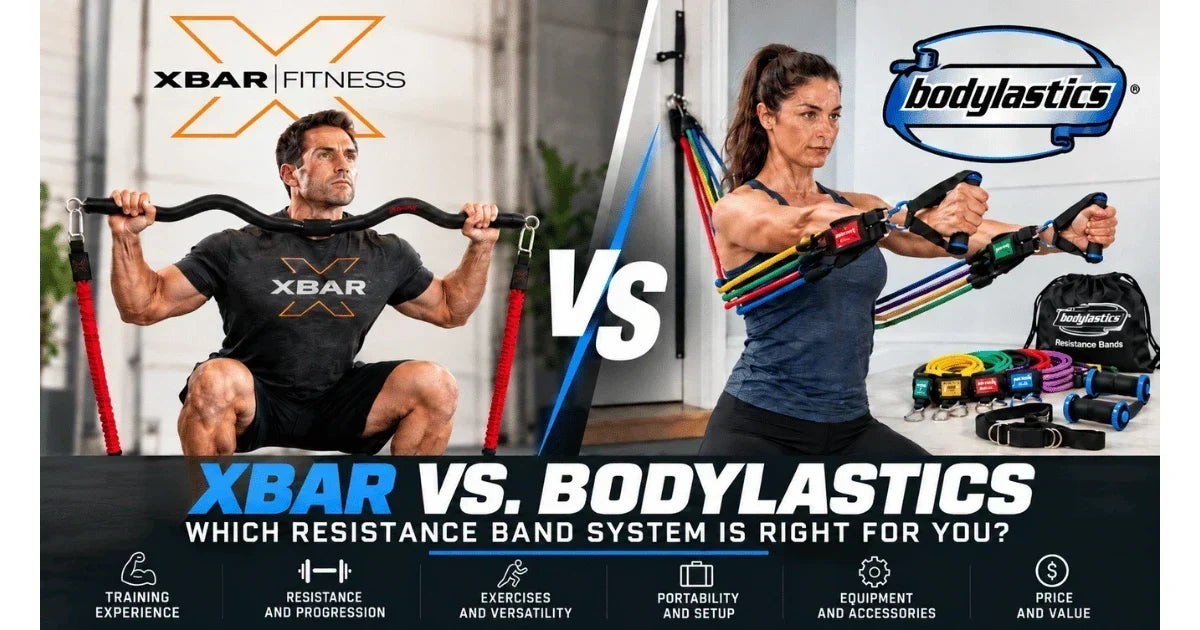
Bodylastics and XBAR can both give you a full-body workout without a rack of dumbbells, stacks of weight plates, or a room dedicated to gym equipment.
But that's about where the similarity ends.
Bodylastics is built around a familiar resistance-band idea: stackable tubes, handles, anchors, and accessories at a relatively low entry price. Its systems can be configured in dozens of ways, and its largest current set advertises more than 1,000 pounds of maximum stacked resistance.
XBAR was designed around a different question:
How much of traditional strength training can you realistically replace with equipment that fits in a bag?
That's why the system centers on a 35-inch training bar rated for up to 500 pounds of resistance, heavier individual resistance options, and RS 2.0 bands protected by reinforced nylon sleeves.
So this comparison isn't really about who can print the biggest resistance number on a product page.
It's about what those numbers mean when you actually train.
How much resistance can a single band provide?
How many tubes do you need to attach to reach heavier loads?
How much resistance is the bar itself rated to handle?
How is the latex protected?
How long does the manufacturer stand behind the equipment?
And ultimately:
Are you buying a resistance-band set, or are you buying a portable strength-training system?
If your primary goal is getting into resistance-band training for as little money as possible, Bodylastics makes a very strong case.
If you're looking for equipment designed to progress with you into heavier bar-based strength training, XBAR is built around a different standard.

1. XBAR vs. Bodylastics at a Glance
| Category | XBAR | Bodylastics |
|---|---|---|
| System approach | Complete portable strength-training system built around a bar | Modular resistance-tube system built around bands, handles and anchors |
| Starting complete system | Complete XBAR Kit: $229 | Basic sets currently start around $35.97 |
| Training bar | Included with XBAR home gym kits | Optional accessory |
| Published bar rating | 500+ lbs | 300 lbs |
| Heaviest individual band | 175 lbs | 160 lbs max published tension |
| Maximum system resistance | 500+ lbs scalable | Up to 1,040 lbs advertised stacked tension |
| Heavy-band protection | Reinforced nylon sleeve over latex on RS 2.0 bands | Internal anti-snap safety cord |
| Bar warranty | 5 years | No equivalent five-year bar warranty stated in current published policy |
| Band/accessory warranty | 1 year | Free replacement for qualifying failures during first 90 days; discounted replacement afterward |
| U.S. shipping | Free $49+; most orders ship next business day Mon.–Thurs. | Free shipping; typically ships within one business day |
| Best fit | Heavier portable strength training and bar-based movements | Low-cost, modular resistance-band training |
Bodylastics wins two comparisons immediately:
Lower entry price. Higher advertised total stacked resistance.
There's no reason to dance around either one.
But neither tells you the whole story.
Because once you move beyond the headline numbers, XBAR's differences start showing up in the places that matter more as your training gets heavier: individual band resistance, bar capacity, band construction, progression, and warranty coverage.
And if you're planning to use this equipment for more than occasional light workouts, those differences deserve more attention than the sticker price alone.
2. Resistance: Don't Just Ask How High the Number Goes
Resistance-band comparisons get messy because manufacturers don't always create resistance the same way.
Bodylastics advertises systems ranging from 190 pounds of maximum tension all the way to a 16-band Pro Series set rated at 1,040 pounds of total maximum tension.
That's an enormous number.
And it isn't something we're going to pretend doesn't matter.
If what you want is a large collection of stackable resistance tubes that can be combined into hundreds of different configurations, Bodylastics gives you plenty to work with.
Its current 1,040-pound Pro Series set sells for $189.97, with a bar that is only rated for 300lbs.
But there's another question worth asking:
How is that resistance being created?
Bodylastics reaches its largest numbers primarily by combining many tubes.
XBAR gives you another path.
Instead of relying only on adding more and more lower-resistance tubes, XBAR increases the resistance of the individual bands themselves.
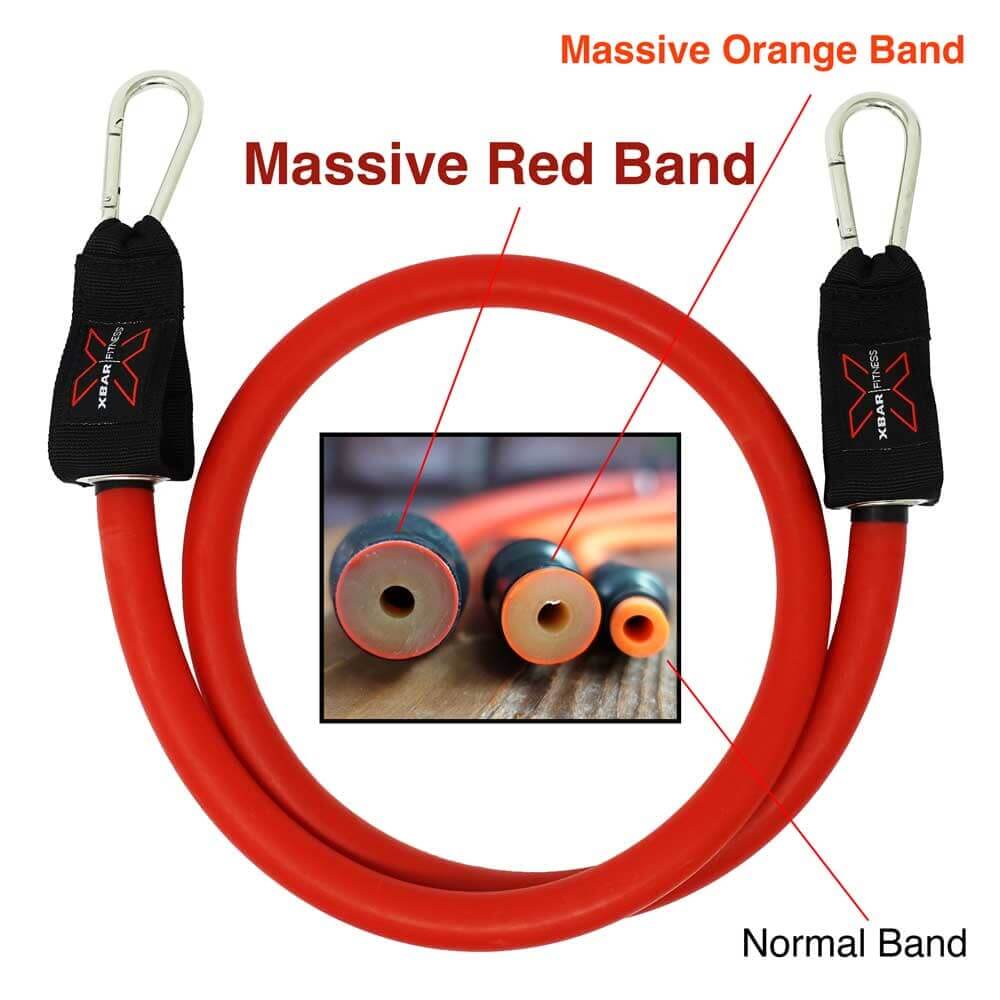
The Massive Red RS 2.0 band is rated at 175 pounds at full length and can provide up to 350 pounds when looped.
XBAR bands can also be combined when additional resistance is needed.
So there are really two different questions here.
Which system advertises the highest theoretical total resistance?
Bodylastics.
Which system offers the heavier individual resistance band?
XBAR.
The current heaviest Bodylastics individual band is listed at up to 160 pounds of maximum resistance.
XBAR's heaviest RS 2.0 band is rated at 175 pounds.
That 15-pound difference sounds modest until you understand the larger design philosophy behind it.
XBAR isn't trying to win a contest over how many tubes you can connect.
It's trying to make heavy resistance simpler to train with.
3. 175-Lb Individual Bands vs. Stacking More Tubes
Imagine you're training heavy squats, deadlifts, rows, presses, shrugs, or curls.
You want more resistance.
There are two basic ways to get it.
You can attach more tubes.
Or you can increase the resistance of the bands you're already using.
Bodylastics specializes in the first approach.
Its largest system achieves that headline 1,040-pound figure by stacking numerous resistance tubes together.
There's nothing inherently wrong with that.
For lighter and moderate resistance, stacking bands can be extremely practical.
But as the load climbs, the training setup starts to matter more.
Some would rather increase resistance by moving to a heavier band than by continuing to add tube after tube, clip after clip, and attachment after attachment.
That's the gap XBAR's heavier RS 2.0 bands are designed to address.
The Massive Red RS 2.0 band reaches 175 pounds at full extension.
Loop it and the resistance can reach as much as 350 pounds.
Need something beyond that?
Multiple XBAR bands can be combined.
The point isn't that stacking bands is bad.
The point is that theoretical resistance and practical resistance aren't always the same thing.
A giant total resistance number looks impressive on a chart.
But when you're standing in the middle of a set of heavy squats or rows, the better question is:
How much equipment do I need to manage to create the resistance I actually want?
XBAR's answer is heavier individual bands and a system built to handle them.
That's why XBAR developed resistance options beyond the common 30-, 50-, 70- and 110-pound ranges.
Not so we could publish a larger number.
But so serious resistance remains practical to use.
4. Band Construction: Protection Where It Matters
Bodylastics deserves credit for taking band safety more seriously than many low-cost resistance-band systems.
Its resistance tubes use a continuous-dip latex process and include an inelastic internal safety cord.
According to Bodylastics, that cord is intended to limit overstretching and help control the tube if the surrounding latex fails.
That's substantially better than buying an exposed bargain-bin resistance tube with no secondary protection at all.
XBAR approaches the same problem differently.
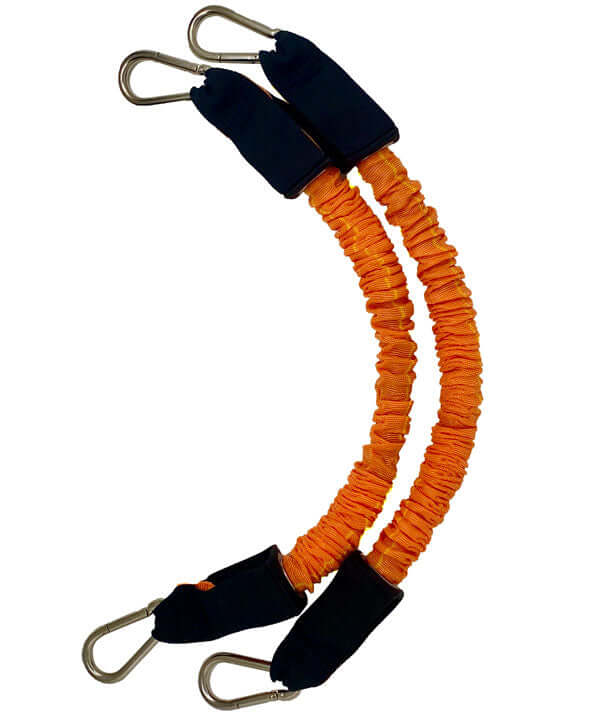
RS 2.0 bands place the latex resistance tubing inside a reinforced nylon outer sleeve.
That distinction matters because the sleeve doesn't just address what happens inside the band.
It also helps protect the resistance tubing from what happens around it.
Every time a resistance band touches the floor, slides against equipment, passes near a doorway, or moves around the bar, there is potential contact with another surface.
A warm-up band and a band being loaded into a heavy squat are not being asked to do the same job.
That's why, for heavier resistance training, XBAR deliberately puts a protective layer around the working latex.
You can see the difference before you perform a single repetition.
The nylon sleeve creates a physical barrier between the resistance tubing and the surfaces around it.
It's not cosmetic.
It's part of how the RS 2.0 system was designed.
Bodylastics protects its tubing with an internal safety cord.
XBAR's RS 2.0 system adds external protection around the latex itself.
Both are legitimate engineering approaches.
But if you're planning to train with increasingly heavy resistance, the protection surrounding the band is worth paying attention to.
5. 500-Lb Bar vs. 300-Lb Bar: Training Headroom Matters
This may be the simplest hardware comparison in the entire article.
The standard 35-inch XBAR is rated for up to 500 pounds of resistance.
Bodylastics' optional resistance-band curl bar is rated to 300 pounds.
Bodylastics says its steel bar was tested beyond that capacity during development, but its published user rating remains 300 pounds.
That's a 200-pound difference in published capacity.
Or approximately 67% more rated capacity for the XBAR.
And that isn't spec-sheet trivia.
It's training headroom.
If you're buying resistance equipment because you intend to get stronger, the last thing you want is for the hardware to become the limiting factor before your training does.
A beginner may never care about the difference between 300 and 500 pounds.
Someone progressively increasing resistance might.
That's the important distinction.
XBAR was designed around bar-based strength movements from the beginning:
-
Squats
-
Deadlifts
-
Rows
-
Curls
-
Overhead presses
-
Chest presses
-
Shrugs
-
And other familiar strength-training movements
The bar isn't an accessory added onto the concept later.
The bar is the structural center of the system.
Bodylastics offers a legitimate resistance-band bar.
XBAR builds the training system around one.
And if you expect your resistance requirements to increase over time, an additional 200 pounds of published bar capacity gives you considerably more room to progress before the equipment becomes the constraint.
6. Warranty: What Happens After the Sale?
Price tells you what equipment costs today.
Warranty tells you something about what happens after you own it.
XBAR currently provides a 5-Year Limited Warranty on the XBAR bar and a 1-Year Limited Warranty on bands and accessories covering defects in materials and workmanship during normal intended use.
Bodylastics changed its published warranty policy effective April 2, 2025.
Under its current policy, if a band or component fails through regular use during the first 90 days, Bodylastics says it will replace the qualifying item free of charge.
After that 90-day period, the policy states that replacement bands or components must be purchased at a discounted price through Amazon.
That's a meaningful ownership difference.
Especially because resistance equipment is not decorative.
It is equipment specifically designed to be repeatedly stretched, loaded, pulled, stepped on, and placed under tension.
The initial purchase price therefore isn't the only cost worth comparing.
You should also ask:
How long does the manufacturer stand behind what you're buying?
For XBAR bands and accessories, the answer is one year.
For the XBAR itself, it's five years.
For Bodylastics, free replacement under its current policy applies during the first 90 days.
A longer warranty doesn't mean equipment can never fail.
Nothing being repeatedly loaded under tension should be treated that way.
But warranty coverage is still part of the value equation.
And when you're comparing equipment you expect to use week after week, it shouldn't be buried in the fine print.
7. Shipping and Delivery
There's no meaningful reason to manufacture a victory here.
Both companies currently publish competitive U.S. shipping policies.
Bodylastics says orders typically ship within one business day, with most arriving within three to five business days. The company also advertises free shipping.
XBAR's current shipping policy says most orders placed Monday through Thursday ship the next business day, with free U.S. shipping on orders of $49 or more.
Customers receive tracking information after shipment.
For international customers, there is a more noticeable difference.
XBAR ships worldwide directly and states that applicable duties and taxes are collected during checkout.
Bodylastics says international shipments are handled through Amazon.
For most U.S. buyers, though, shipping probably shouldn't decide this comparison.
The equipment should.
8. What's Included for the Money?
This is where Bodylastics deserves real credit.
A five-band Basic Series set currently starts around $35.97.
Its five-band Pro Series is listed at $49.97 and includes:
-
Five resistance bands
-
Professional door anchor
-
Two handles
-
Two ankle straps
-
Backpack-style bag
Those bands provide up to 190 pounds of advertised maximum stacked resistance.
For roughly fifty dollars, that's a lot of resistance-band equipment.
If that's what you're looking for, the value proposition is obvious.
The Bodylastics resistance-band bar is sold separately and currently costs approximately $86–$88.
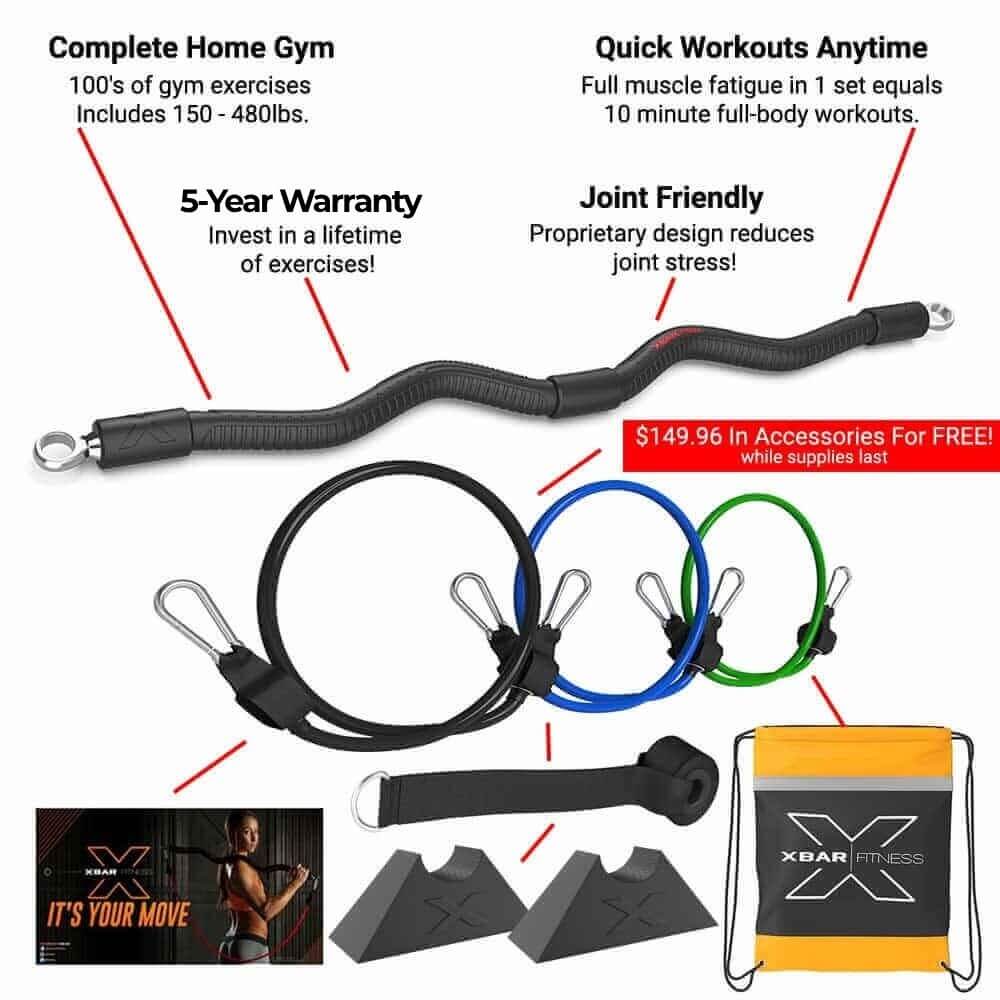
The Complete XBAR Home Gym Kit costs $229 and includes:
-
35-inch XBAR rated for up to 500 pounds
-
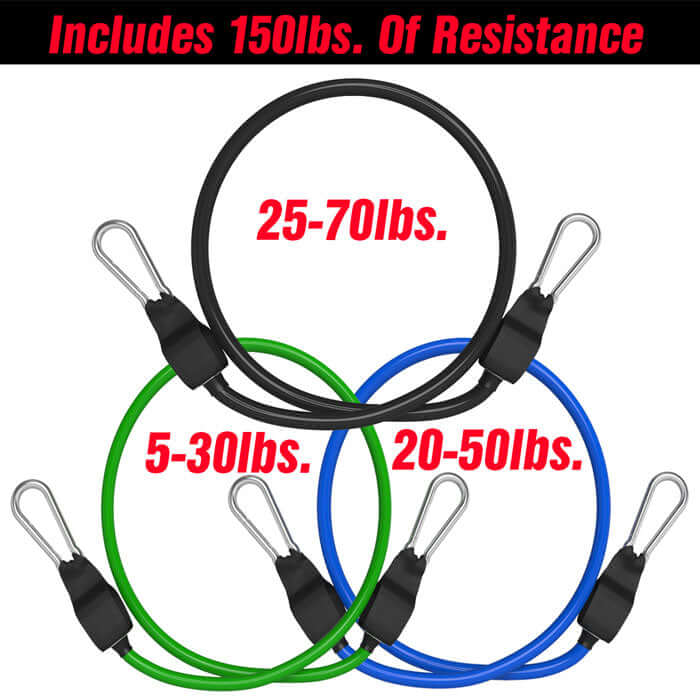
Three resistance bands providing 150+ pounds of combined resistance
-
Two push-up docks
-
Full-door anchor
-
Travel bag
-
Training guide
-
Access to XBAR's online workout library
So yes:
XBAR costs more.
The question is whether you're comparing the same thing.
Bodylastics is essentially asking:
How inexpensively can we give someone a flexible collection of resistance bands and attachments?
XBAR is asking:
How much conventional strength-training capability can we put into a portable system?
Those are two very different design goals.
If all you want is handles, tubes, anchors, and inexpensive resistance, paying for a heavier-duty bar-centered system may make no sense.
But if you're trying to replace more of what you would ordinarily do with dumbbells, barbells, benches, or larger home-gym equipment, comparing only the sticker price becomes misleading.
You're not simply buying more bands.
You're deciding what role you want the equipment to play in your training.
9. Which System Is Better for Heavy Strength Training?
If your workouts are primarily built around lighter resistance, mobility work, rehabilitation-style movements, accessory exercises, or general fitness, both systems can provide plenty of resistance.
The difference becomes more noticeable as your training gets heavier.
XBAR combines:
A 500-pound-rated bar.
Individual resistance bands reaching 175 pounds.
RS 2.0 reinforced outer sleeves.
The ability to loop or combine bands for additional resistance.
Bodylastics can also generate very large amounts of resistance.
Its largest system advertises up to 1,040 pounds of maximum stacked tension.
That's substantially higher than XBAR's published scalable system figure.
But once again, the question isn't only:
How high can the theoretical total go?
It's also:
How do I want to get there?
If you're comfortable combining numerous smaller tubes and primarily training from handles, anchors, and modular attachments, Bodylastics gives you an enormous number of possible configurations for the money.
If you'd rather build resistance around a smaller number of heavier individual bands connected to a bar rated for up to 500 pounds, XBAR was designed around that training style.
Think of the difference this way:
Bodylastics emphasizes more combinations.
XBAR emphasizes more strength-training structure.
For someone trying to reproduce the familiar feel and progression of bar-based strength movements in a portable format, that distinction matters.
10. Which Is Better if Price Is Your Main Concern?
Bodylastics.
There's no clever marketing answer required.
If your number-one priority is:
“Give me the most versatile resistance-band workout I can get while spending as little as possible,”
Bodylastics is difficult to beat.
Its complete entry-level systems start at a fraction of the price of the Complete XBAR Home Gym Kit.
Even its larger Pro Series systems remain competitively priced.
XBAR is not trying to win the cheapest-resistance-band-set-on-the-internet contest.
There will almost always be somebody willing to sell a resistance tube for less money.
The reason XBAR costs more is because you're buying a different type of equipment:
-
A bar rated for up to 500 pounds
-
Heavier individual resistance options
-
Reinforced RS 2.0 sleeves
-
Integrated bar-based training
-
Longer published warranty coverage
-
A system designed to progress from relatively light resistance into genuinely heavy strength work
That doesn't automatically make XBAR the right choice for everyone.
It makes the buying decision clearer.
If you want inexpensive resistance bands, buy inexpensive resistance bands.
If you want equipment intended to replace a meaningful portion of conventional strength-training equipment while remaining portable, compare the systems on that basis.
Because once that's the goal, lowest purchase price stops being the most important number.
11. XBAR vs. Bodylastics FAQ
Does Bodylastics have more resistance than XBAR?
Bodylastics advertises the higher maximum theoretical stacked resistance. Its largest current system is marketed at up to 1,040 pounds of total maximum tension by combining multiple resistance tubes.
XBAR offers 500-plus pounds of scalable resistance but uses heavier individual resistance bands, including a 175-pound RS 2.0 band.
The difference is therefore not simply how much total resistance each company can advertise, but how that resistance is created and used.
What is the heaviest XBAR resistance band?
XBAR's Massive Red RS 2.0 band is rated at 175 pounds at full length and up to 350 pounds when looped.
The latex resistance tubing is surrounded by a reinforced nylon sleeve.
What is the heaviest Bodylastics individual resistance band?
Bodylastics currently lists its Grey individual band at up to 160 pounds of maximum resistance.
Higher Bodylastics system resistance figures are achieved by combining multiple bands.
Which bar can handle more resistance?
XBAR publishes a resistance capacity of up to 500 pounds for its exercise bar.
Bodylastics publishes a 300-pound rating for its optional resistance-band curl bar.
That gives the XBAR 200 pounds of additional published capacity, or approximately 67% more rated headroom.
Are XBAR RS 2.0 bands sleeved?
Yes.
XBAR RS 2.0 bands place the latex resistance tubing inside reinforced nylon sleeves designed to add abrasion protection and create a barrier between the working latex and surrounding surfaces.
Does Bodylastics have anti-snap technology?
Yes.
Bodylastics uses an inelastic cord inside its resistance tubes that the company says helps limit overstretching and control the tube if the surrounding latex fails.
Which has the better warranty?
The policies are structured differently.
XBAR provides a five-year limited warranty on the XBAR bar and a one-year limited warranty on bands and accessories.
Bodylastics' current published policy provides free replacement for qualifying failures during the first 90 days. After 90 days, replacement products must be purchased at discounted pricing.
For buyers planning to keep and regularly use their equipment, that difference is worth factoring into the total value of the system.
Is Bodylastics cheaper than XBAR?
Yes.
Bodylastics basic resistance-band systems start substantially below the $229 Complete XBAR Home Gym Kit.
If lowest initial purchase price is your primary buying criterion, Bodylastics has the advantage.
XBAR competes on a different combination of bar capacity, heavier individual resistance, sleeved band construction, bar-based training, and longer warranty coverage.
Does XBAR require an app or membership?
No.
XBAR equipment can be used without a paid membership or subscription.
XBAR customers also receive access to training resources and workout programs.
Can both systems travel?
Yes.
Both systems are portable.
Bodylastics bands and handles can pack particularly small, and its optional bar separates into two pieces.
The 35-inch XBAR does not collapse, but it is designed to fit inside a large suitcase or gym bag, with the bands and accessories carried in the included bag.
12. Bottom Line: Decide What You're Actually Buying
Bodylastics and XBAR can both deliver full-body resistance training.
But they're not really chasing the same customer.
Bodylastics is inexpensive, modular resistance-band equipment.
XBAR is purpose-built portable strength equipment.
That distinction explains most of the differences between them.
Bodylastics has the advantage if your priorities are:
-
Spending as little as possible
-
Owning a large number of resistance combinations
-
Using independent handles and anchors
-
Achieving an extremely high theoretical resistance total by stacking multiple tubes
Its larger systems offer an impressive amount of equipment for the money.
XBAR's advantages appear when the question changes from:
“How cheaply can I buy resistance bands?”
to:
“How far can I realistically progress with this equipment?”
The XBAR itself is rated for 500 pounds of resistance versus 300 pounds for the Bodylastics optional bar.
XBAR offers a 175-pound individual RS 2.0 band versus Bodylastics' current 160-pound maximum individual band.
XBAR's heavy RS 2.0 resistance tubing is surrounded by reinforced nylon sleeves.
And XBAR backs its bar with a five-year limited warranty and its bands and accessories with a one-year limited warranty, while Bodylastics' current policy provides free replacement for qualifying failures during the first 90 days and discounted replacement purchases afterward.
Those aren't vague claims that one product is somehow more “premium.”
They're measurable differences.
And they point toward two different buying decisions.
If what you want is an inexpensive collection of resistance tubes, handles, and anchors, Bodylastics remains a compelling value.
You could spend substantially less money and get everything you need for plenty of effective workouts.
But if you're looking at resistance bands because you want to replace more of the barbell, dumbbell, and home-gym experience — without giving up the ability to progressively train heavier — then the comparison changes.
You don't just need more bands.
You need equipment that gives those bands structure.
You need resistance that can grow with you.
You need hardware capable of handling that resistance.
And once the load gets heavier, construction and warranty become much more important than they seemed when you were shopping for your first 20-pound tube.
That's what XBAR was built for.
Not to be the cheapest set of resistance bands.
To make serious strength training portable.
Train anywhere. Progress as far as you want.
Explore the Complete XBAR Home Gym Kit — $229